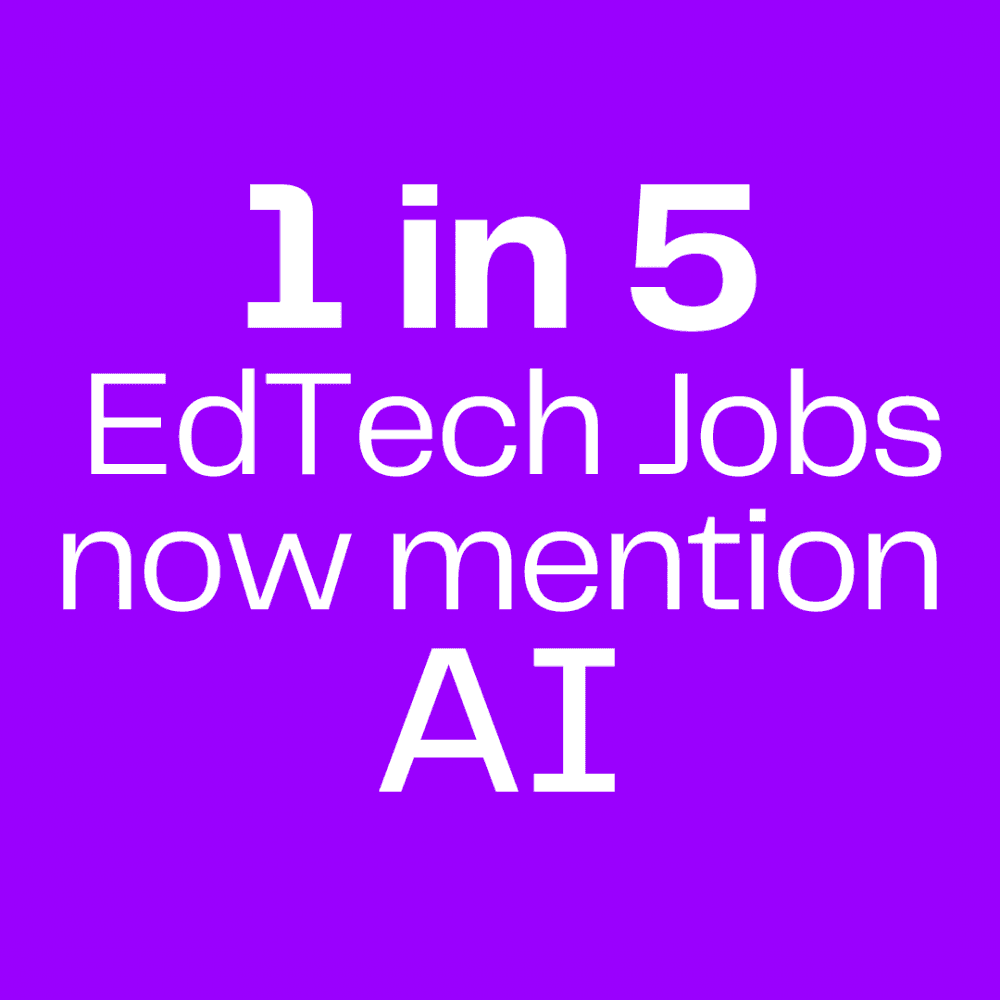
The education technology landscape is undergoing a rapid transformation, and the catalyst is clear: artificial intelligence. What started as hype with tools like ChatGPT is now moving into serious implementation in education. For EdTech job seekers, this means exciting new career paths are emerging – and some familiar roles are evolving with an AI twist. In fact, in just July 2025, about 1 in 5 new EdTech job listings have mentioned AI skills or focus, reflecting how in-demand this expertise has become. Whether you’re a teacher transitioning into tech or a developer in the industry, understanding these trends will help you navigate your next career move.
New Roles Born from the AI Boom
AI isn’t just automating tasks; it’s creating entirely new jobs in the EdTech sector. Companies across K-12, higher education, and corporate learning are investing in AI-driven products and need talent to build and support them. Many of these positions simply didn’t exist a few years ago. For perspective, about 21% of EdTech job posts in the past month explicitly reference AI a number that will continue to grow. Here are the top five AI-inspired EdTech jobs making their mark, with real examples posted on EdTechJobs.io:
- AI / Machine Learning Engineers: As AI becomes integral to educational products, demand is surging for engineers who can develop and integrate these features. EdTech companies are hiring AI specialists to build everything from adaptive learning algorithms to AI teaching assistants. For example, Quizlet recently sought an Principal Engineer - AI/ML to help “As a Principal AI Engineer, you will be a key individual contributor, leading the technical vision and development that will define the future of AI in education.” Likewise, organizations like Khan Academy are hiring AI engineers to work on projects like their AI tutor (Khanmigo) aimed at equitable learning support. If you have a software engineering background and a knack for AI, these roles are calling.
- AI Product Managers: Product management in EdTech now often requires an AI lens. These PMs drive the strategy and development of AI-powered features that improve learning outcomes or efficiency. A recent opening at Noodle for an AI Product Manager illustrates this trend: the role focuses on launching AI-driven products to enhance online learning experiences. In practice, AI Product Managers collaborate with engineers and educators to ensure new AI tools truly solve problems for students and teachers. This is a great path if you sit at the intersection of education, technology, and business and can translate AI capabilities into user-friendly solutions.
- AI Curriculum and Training Specialists: As schools and companies adopt AI, there’s a growing need for experts who can train others to use these tools and who can develop content around AI literacy. These roles are often new in nonprofits, schools, and content organizations. For instance, Common Sense Media created positions like AI Professional Development Fellow and Professional Development Content Designer (AI Programs) to help educators incorporate AI responsibly in the classroom. These specialists design workshops, curricula, and resources to upskill teachers and staff on AI. It’s a role that blends instructional design with cutting-edge tech roles that blend instructional leadership with EdTech integration are booming, especially as states invest in AI literacy initiatives. If you have teaching experience and a passion for AI, consider this emerging career track.
- AI Ethics and Policy Analysts: With great power comes great responsibility and new jobs to ensure AI is used ethically in education. Organizations are hiring for roles like AI Risk Assessment Analyst and AI Policy Fellow to evaluate AI tools for bias, privacy, and safety concerns. Common Sense Media, for example, recently listed an AI Risk Assessment Fellow to analyze the impact of AI programs on students. These roles involve setting guidelines for responsible AI use, vetting third-party AI products, and staying on top of evolving regulations. They didn’t really exist pre-AI boom, but now every major EdTech player needs people who can ask the tough questions about algorithmic fairness and data security. A background in research, policy, or ethics (plus some tech know-how) is typically required for these positions.
- AI Marketing and Optimization Specialists: AI is not only changing product development but also how companies market and optimize their content. A good example is the AI Search Optimization Specialist role at Lucid Software essentially an SEO expert for the age of AI. This new specialist focuses on ensuring the company’s content is discoverable and cited by AI-driven search tools and chatbots (think making sure a learning product shows up in a ChatGPT response). Similarly, some companies are hiring AI-powered Learning Designers or AI and Marketing Intelligence analysts to leverage AI in tailoring content and outreach. Even leadership roles are evolving in this direction. MagicSchool AI recently posted for a Director of Talent who, beyond overseeing recruitment and retention, is tasked with attracting and developing talent skilled in AI integration and educational AI tools. It’s a clear signal that AI expertise is becoming a strategic priority across all levels of EdTech organizations.
Examples of other AI-related roles:
- Senior Product Designer – Government SaaS @ Wonderschool (K-12): Designing AI-informed tools for early childhood education and government programs.
- Senior Director of Planning, Analytics, and Risk Assessment @ Fordham University (Higher Ed): Leading AI-driven analytics to improve institutional planning and student outcomes.
- Director, Revenue Enablement @ Relias (Corporate): Leveraging AI to optimize sales strategies and customer engagement.
AI vs. Non-AI Job Trends
If you think AI jobs are just a niche corner of the EdTech market, think again. In just the month of July 2025, about 21% of all new job listings on EdTechJobs.io explicitly mention AI in the job title, tags, or description. Corporate roles lead the way (31%), followed by Higher Ed (24%), then K-12 (17%).
What this means for your EdTech job search:
- AI literacy is quickly becoming a baseline. You’ll see far more AI in descriptions than in job titles, so don’t filter only for “AI” in the title. Be sure to open the post and review responsibilities.
- Every function is being “AI-enabled". Product, marketing, sales, ops, customer success, curriculum, and even talent roles now reference AI fluency.
- K–12 will follow fast. As districts adopt AI literacy standards and tools, expect the K-12 share to climb over the next 6-12 months.
Skills in Demand in a Post-AI World
What skill set will help you thrive in this AI-influenced job market? Here are a few in-demand skills and qualities that EdTech employers are looking for:
- AI Literacy & Tools: You don’t necessarily need to be a programmer for every role, but you should be comfortable using AI in your domain. Familiarity with generative AI tools (e.g. ChatGPT, Gemini) and concepts like prompt engineering, AI-driven analytics, or agentic AI is a big plus. For technical roles, experience with machine learning frameworks, large language models (LLMs), and libraries like TensorFlow or LangChain is often required.
- Data Analysis: AI thrives on data. Many AI-related jobs require strong data skills from analyzing user data to training AI models. SQL, Python, and data visualization skills (Tableau, etc.) are frequently mentioned in job postings. Being able to interpret and leverage data (even data produced by AI systems) will set you apart.
- Adaptability & Continuous Learning: The AI field moves fast. Employers value candidates who can learn new technologies quickly and adapt as tools evolve. Show that you’ve stayed current with AI trends. Perhaps you’ve taken a course on AI in education, or you experiment with new AI tools. An open, curious mindset is key.
- Ethics & Responsible Use: Especially in education, understanding the ethical implications of AI is critical. Skills in evaluating bias, ensuring accessibility, and maintaining data privacy are increasingly sought after. If you can demonstrate that you think critically about AI’s impact on learners and society, you’ll hit a chord with mission-driven EdTech employers.
- Domain Expertise with AI Application: Lastly, don’t forget your core education or business expertise. AI is most powerful when paired with deep knowledge of the problem domain. Teachers who know how to use AI to save time on lesson planning, or a marketing professional who can deploy AI for personalized campaigns. Those combinations are golden! Emphasize how your educational domain experience plus AI know-how can create real impact.
Navigating Your Career in the AI Era
The advancement of AI is changing the rules of the game for job seekers, but it’s an opportunity as much as a challenge. If you’re searching in the EdTech arena, consider targeting roles that leverage AI or upskilling yourself to meet the new demand. Many employers are not just looking for “AI experts”. They want educators, designers, marketers, and leaders who know how to use AI as a force multiplier. This can mean highlighting a project where you implemented an AI tool, or simply expressing your enthusiasm and ideas for AI in education during interviews.
Call to Action: Ready to find your place in this dynamic market? Check out the latest AI-related EdTech job openings on EdTechJobs.io. New positions in this area are being posted daily. You might discover your perfect fit in one of these AI-enabled roles.
Finally, remember that the rise of AI doesn’t replace the human element. It elevates it. Education will always need passionate people. By embracing AI, you’re positioning yourself to do what humans do best in edtech careers: innovate, empathize, and make learning better for everyone. Stay curious, keep learning (machine or otherwise!), and go get that dream job!