
Are you getting crickets instead of callbacks? You’re not alone. In one of our recent LinkedIn polls, we asked "If you’re moving from classroom to EdTech, what’s hardest right now?" We saw that Getting callbacks won by a landslide (65%), with Tailoring resume (16%) and Picking roles (15%) far behind, and Interview prep (3%) rounding it out.
The results are clear... and they’re connected. Most “no callback” situations trace back to role targeting and resume targeting. If you don’t aim at the right role (or speak its language), great experience gets filtered out before a recruiter ever gets to see. This poll emphasized that clear role fit + tailored signal beats application volume every time.
The callback bottleneck: 3 failures we see over and over
- Role mismatch (or ambiguity): If you’re a former educator who’d thrive as a Customer Success Manager, Sales Engineer, or Instructional Designer, but you’re applying to generic “EdTech” roles (or everything), you’ll look unfocused. Titles vary by company For example, “Implementation,” “Onboarding,” “Learning Experience,” “Program Manager” can point to similar skill sets. Wrong target → wrong keywords → low match → no call.
- Generic resume (not mapped to the job description): Applicant tracking systems and recruiters scan for the job’s specific vocabulary (customer renewals, onboarding, LMS authoring tools, discovery questions, product feedback loops, analytics, etc). A single, static resume can be strong… and still miss the match.
- Cold apply without context: Even a well-aimed, tailored resume benefits from a short warm-up like a comment on a recent company update, a quick DM to the recruiter or future teammate, or an alum connection. That context can lift you to a human review.
How Picking roles + Tailoring resume gets you callbacks
- Picking roles narrows your story. You translate “teacher / coach / admin” into one or two target "lanes" (e.g., CSM or Implementation), each with clear problem statements you’ve solved and tools you’ve used.
- Tailoring resume broadcasts the right keywords, outcomes, and artifacts for that lane (renewals %, onboarding time saved, courses shipped, assessment analytics, etc.).
- Together, they increase your relevance score which is what gets you out of the filter and into a conversation.
Fast wins this week (job seekers)
- Pick 1-2 lanes and learn their language: Start with common bridges from education: Customer Success, Customer Support, Implementation, Trainer, Sales Development Representative, Sales Engineering, Instructional Design, Product Support, Program/Project Management, Product Operations, Curriculum/LX Design, Product Manager (junior). Write a one-sentence “why me” for each.
- Create a modular resume: Keep a strong base, then build lane modules you can swap in: a summary sentence, 5-7 keywords, and 4-6 bullets quantified for that lane (renewal %, time-to-live reductions, course / assessment outcomes, stakeholder adoption).
- Tailor to the Job Description: Mirror the posting’s verbs, tools, and outcomes. If the job description says “renewals, onboarding, QBRs”, your bullets should say exactly that (with your numbers). If it says “Articulate, Canvas”, include the tools you’ve actually used.
- Add one warm touch per application: A short LinkedIn message to the recruiter or a future teammate that references something specific (recent launch, mission, customer segment) + a question. You’re not asking for a job, you’re signaling fit.
- Don’t get stuck on titles... follow problems: Search by problems you’ve solved (e.g., “onboarding schools,” “LMS migration,” “assessment analytics”), not just titles. Then save the best companies and set a simple weekly cadence for outreach and follow-ups.
Explore active roles and employers here:
• Jobs → https://edtechjobs.io/jobs
• Companies → https://edtechjobs.io/companies
Practical tips for Employers
- Be explicit about the lane. Use a clear title and 3-5 must-haves (outcomes + tools).
- Show mission and team context. Candidates from education lean in when they see the “why” and who they’ll work with.
- Share salary ranges and location stance. It filters in the right people and saves everyone time.
- Respond quickly with a short screen. A 15-minute “skills + motivations” screen within a week preserves momentum and improves candidate experience.
- Offer a role sample or rubric early. A short scenario or rubric helps career-switchers self-assess and submit a stronger resume.
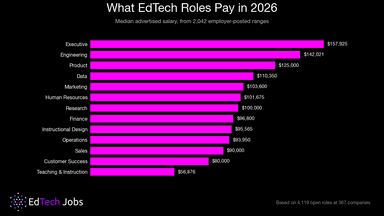
For broader market context and role breakdowns, see our recent article on trends and role paths in EdTech.
What we’re building next
We’re heads-down on a new resource designed to raise your callback rate by solving the three problems above: role targeting, resume targeting, and smart outreach. It will help you:
- Map your background to specific EdTech roles (with language you can use),
- Tailor your resume to any chosen job post in minutes, and
- Generate polished follow-ups (email + LinkedIn) with a simple cadence you can actually keep.
If you’d like to be notified the moment it’s available, join the waitlist here:
Final thought
The poll results are a reminder: callbacks aren’t random. They’re the outcome of focused role choices + targeted signal + light networking. Get those three right, and the interview invites follow. We’ll keep building tools and guides that make that path faster. We can’t wait to get our next resource into your hands.