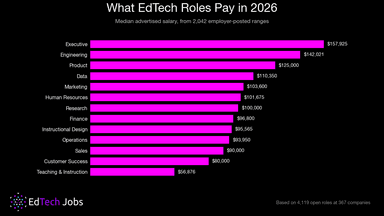
In August we published our mid-2026 EdTech hiring report. It showed what employers are offering, including what they pay, what they hire for, and where the work happens. Most EdTech roles, it turned out, are on-site.
That told us what employers want. So we asked job seekers what they want. We ran a poll for our 134,000 LinkedIn followers, then compared the answers with the listings candidates actually open and apply to on EdTechJobs.io.
In short, job seekers overwhelmingly want remote work, and their clicks back that up. But the on-site roles almost nobody asks for convert the people who find them at nearly twice the rate.
What job seekers want vs. what employers offer
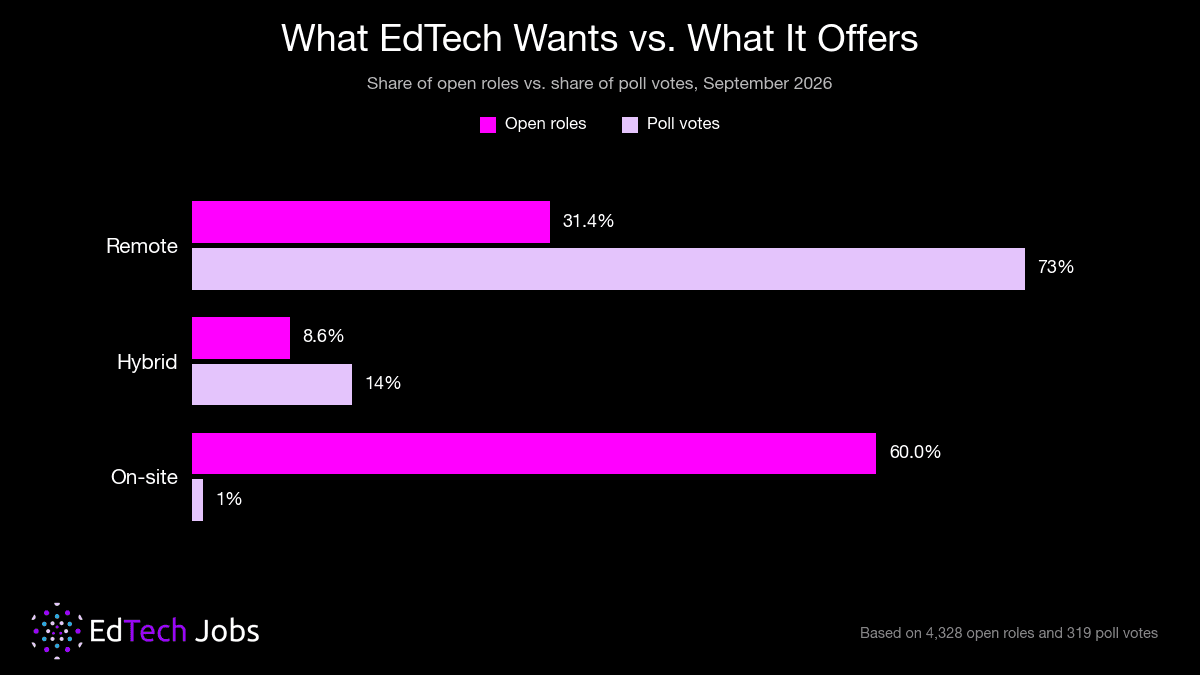
We asked, "What work setup do you want in your next EdTech role?" and 319 people voted. Here is how their answers compare with the 4,328 live EdTechJobs.io listings whose work setup we can confirm.
| Work setup | Share of open roles | Share of poll votes |
|---|---|---|
| Remote | 31.4% | 73% |
| Hybrid | 8.6% | 14% |
| On-site | 60.0% | 1% |
| Open to any setup | n/a | 12% |
Three in five EdTech jobs are on-site. One in a hundred voters wants one.
We want to be careful with that 1%. People who vote in a LinkedIn poll chose to, and people hoping for remote work had the most reason to stop and answer. Many on-site EdTech roles are in schools, districts, and learning centers, and the educators who fill them may not be scrolling a job board's LinkedIn feed. So read 1% as "on-site was the least-wanted option by a wide margin," not as a measurement of every EdTech job seeker. That is also why we did not stop at the poll.
A correction before we go further
Our mid-2026 report said under 3% of EdTech roles were hybrid. That was wrong, and the error was ours.
While preparing this post, we found that our system recognized a hybrid role only when the word "hybrid" appeared in the job's location or title. When an employer described the arrangement in the job description instead, for example "three days a week in our Boston office," we recorded the role as on-site. Several of the applicant tracking systems we pull listings from also publish a hybrid flag that we were not reading.
We fixed both this week. Hybrid now accounts for 8.6% of classified roles, roughly three times what we reported, and the on-site share falls from 65% to 60%. The main finding of that report still holds. On-site is still the majority of EdTech hiring, and remote is still about a third. But the hybrid figure was materially understated, so please use the numbers in this post instead.
Our hybrid count is still conservative. Where only our own AI-written job summary called a role hybrid, and the employer's description did not say so, we left it as on-site.
Remote listings get almost six times the attention
A poll tells you what people say. Our traffic tells you what they do. Here is candidate activity over the last 90 days, measured per day each listing was live, so older listings do not get a head start.
| Work setup | Page views per 1,000 listing-days | Apply clicks per 1,000 listing-days |
|---|---|---|
| Remote | 1,776 | 492 |
| Hybrid | 411 | 63 |
| On-site | 301 | 153 |
A remote listing draws about 5.9 times the page views of an on-site one, and more than three times the apply clicks.
This is not because remote jobs happen to sit in more popular fields. We ran the same comparison inside individual job functions, remote sales against on-site sales, remote engineering against on-site engineering, and remote won every one, by margins from about 2.5x in engineering to 9x in sales.
The poll and the clicks agree. EdTech job seekers want remote work, and they go looking for it.
On-site listings convert best
Here is the number that surprised us. We looked at what share of job page visits ended in an apply click.
| Work setup | Visits that led to an apply click |
|---|---|
| On-site | 50.9% |
| Remote | 27.9% |
| Hybrid | 15.3% |
People who open an on-site listing click apply about half the time. People who open a remote listing do so a little more than a quarter of the time.
We think remote listings attract a lot of browsing. Someone looking for anything remote opens many listings and applies to a few. Someone who opens an on-site listing has usually already decided the location works, often because it is near them. They arrive ready to act.
That changes the problem for employers hiring on-site. It is not that nobody wants the job. It is that far fewer people ever see it. The candidates who do find it are serious.
What about hybrid?
Hybrid listings show the lowest apply rate of the three. We would not draw conclusions from that yet. Until this week, about half of the listings we now classify as hybrid were shown to candidates as in-person, so much of the traffic behind them was measured under the wrong label. We will revisit hybrid in our next report, once it has a few months of clean data behind it.
What we can say today is that 14% of voters want hybrid, and 8.6% of roles offer it. Of the three setups, it is the only one where demand and supply are in the same neighborhood.
What this means if you are hiring in EdTech
- If your role is remote, say so in the title. Remote is where the attention is. Make sure someone scanning a list of jobs can see it without opening the listing.
- If your role is on-site, your challenge is reach, not appeal. People who find on-site listings apply at the highest rate on the board. Put your effort into being seen, with a complete listing, a clear location, and a company profile that explains why the place matters.
- If your role is hybrid, spell out the schedule. "Hybrid" on its own is vague. "Three days a week in our Austin office" tells a candidate exactly what they are signing up for.
- Setup and pay come first. In our previous poll, 64% of voters said a missing salary is what makes them skip a listing fastest. Work setup and pay are the two things candidates check before anything else, so put both where they cannot be missed.
What this means if you are looking
Remote roles draw more than three times the apply clicks of on-site roles for every day they are live. If on-site or hybrid work near where you live is an option for you, you are competing in a much smaller pool. Search your area on EdTechJobs.io, and take a second look at the on-site roles you might usually scroll past.
About this data
The poll drew 319 votes on the EdTechJobs.io LinkedIn post in September 2026. Voters chose to take part and include employers as well as job seekers, so the results describe the people who answered, not the whole EdTech workforce.
The listing figures cover 5,058 live roles on EdTechJobs.io as of September 18, 2026. Of those, 4,328 have a work setup we can confirm. The rest name only a country or give no location, and we do not guess.
Engagement counts page views and apply clicks over the trailing 90 days, divided by the number of days each listing was live in that window. Apply clicks are counted only for listings that send candidates to an external application. We promote remote roles through site filters and social posts, so part of remote's attention advantage reflects our own promotion as well as candidate demand. Views and clicks are not de-duplicated by person.
The hybrid and on-site shares in our mid-2026 report were affected by the classification error described above. That post now carries a correction note.
Is there a question you want us to put to the EdTech community next? Tell us.
- Work with Purpose 💜